
More Connectivity, More Devices: New BitFlow BitBoxâ„¢ is Optimal I/O Solution for Machine Vision
Designed for the Industrial Internet of Things
WOBURN, MA, JANUARY 16, 2018 -- The Industrial Internet of Things (IIoT) connects all technologies, systems, and components involved in the industrial value creation process to each other as well as to company networks and the Internet. With connectively playing a critical role in this scenario, BitFlow today announced it is shipping a new breakthrough I/O device for machine vision which provides an unprecedented 36 inputs and 36 outputs in a compact, DIN-rail mounted form factor supporting TTL, LVDS, open collector, opto-isolated and 24V signaling.
Amazingly simple to deploy, the BitFlow BitBox is controlled solely by a BitFlow frame grabber, using the same API, driver and manual -- reducing space requirements and flattening the learning curve for customers. It contains 12-pin connector blocks that are added or removed easily, yet still lock securely in place for factory floor reliability. Blocks are logically grouped by signal type and have snap-in connectors that allow the fabrication of a harness without directly wiring the BitBox.
"In IIoT environments, machine vision helps in the monitoring of production processes to pinpoint weak spots and optimization potentials, along with the technology's traditional duty of identifying faulty parts; the challenge is connecting machine vision with other systems," said Donal Waide, Director of Sales for BitFlow. "Our new BitBox is a cost-effective, reliable way to connect and control dozens of devices such as strobes, solenoids and actuators, while acquiring data input from equipment ranging from photo detectors to triggers. It is the ideal solution for high-density networked systems."
Until now, Waide explains, the answer for connecting machine vision components has been to purchase an I/O card. However, this step requires additional costs, software, system complexity, and the use of a PC slot. In addition, traditional I/O cards put all transmitters and recievers on the actual board in the PC, thus requiring wires to travel from their sources all the way back to the PC, which is often located quite a distance from other equipment. Besides being added potential points of failure, this extended wiring can cause signal lag, and even lead to employee trip-and-fall accidents.
In contrast, the BitBox contains all transmitters and receivers with a small high-speed 15-wire cable running between the BitBox and the frame grabber. Maximum length cable is a generous 10 meters, providing maximum flexibility in positioning equipment within the machine. This arrangement isolates noisy, high-voltage signals generated by the PC away from the machine where they could cause data drops, video problems, malfunctions and random network errors.
The BitBox was designed with maximum flexibility in mind. For example, outputs can be elected to be driven either to the static level via software API or configuration files, or from a frame grabber's internal signal generators. Likewise, inputs can be routed to a number of different blocks on the frame grabber. Input signals can also be routed to other outputs, including to the camera where it can also cause an interruption, or start/end acquisition.
For more information, please call 781-932-2900 or visit www.bitflow.com.
Featured Product
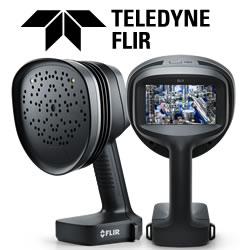
FLIR Si1-LD - Industrial Acoustic Imaging Camera for Compressed Air Leak Detection
The FLIR Si1-LD is an easy-to-use acoustic imaging camera for locating and quantifying pressurized leaks in compressed air systems. This lightweight, one-handed camera is designed to help maintenance, manufacturing, and engineering professionals identify air leaks faster than with traditional methods. Built with a carefully constructed array of MEMS microphones for high sensitivity, the Si1-LD produces a precise acoustic image that visually displays ultrasonic information, even in loud, industrial environments. The acoustic image is overlaid in real time on a digital image, allowing you to accurately pinpoint the source of the sound, with onboard analytics which quantify the losses being incurred. The Si1-LD features a plugin that enables you to import acoustic images to FLIR Thermal Studio suite for offline editing, analysis, and advanced report creation. Field analysis and reporting can also be done using the FLIR Acoustic Camera Viewer cloud service. Transferring of images can be managed via memory stick or USB data cable. Through a regular maintenance routine, the FLIR Si1-LD can help facilities reduce their environmental impact and save money on utility bills.