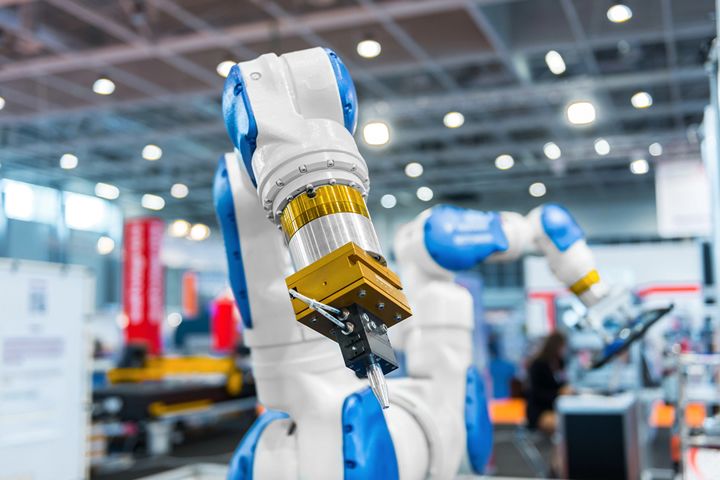
I'm most excited about Cognitive AI becoming the factory's operating system, and cobots will effectively "program themselves" through natural language, teach-by-demonstration, and auto-generated PLC/robot code.
 How AI, Robotics, and Digital Twins are Transforming Modern Production Environments
Q&A with Vijay Gurav, Industrial Engineer and Six Sigma Black Belt
Modern assembly lines are evolving rapidly with robotics, sensors, and AI-driven analytics. From your perspective, what defines a truly “smart” assembly line in today’s Industry 4.0 environment?
A smart assembly line is a closed-loop, product-centered, self-optimizing system. It senses with robots and sensors, predicts with edge AI, and adjusts in real time without waiting for a decision making meeting. Orders flow through MES (Manufacturing Execution System) to stations, takt time rebalances automatically, SPC (Statistical Process Control) stops drift before defects, and predictive maintenance fixes issues before breakdowns. Every shift, it proves results on OEE, safety, quality, delivery, cost, and energy. Think of it as demand-to-delivery with full traceability and a digital twin that tests changes before the production floor feels them.
In short, a truly smart assembly line measures constraints and automatically balances people, robots, and buffers to increase business profitability.
Many manufacturers worry that automation will replace human roles. How do you see the relationship between human intelligence and machine automation evolving on the factory floor?
It’s shifting from replacement to augmentation. Machines handle the dangerous, repetitive, and heavy, non-ergonomic work while humans own judgment, exception handling, and continuous improvement. Think cobots for ergonomics, AR work guidance for faster onboarding, and edge AI that flags issues while operators decide the fix. Simple break into: Automation will support repetitive work; humans will assist in Poka-Yoke, Andon alerts, and digital instructions, and also work more on continuous improvement, complex problem solving, and production uncertainties.
The control model will stay with human intelligence to stop the production line on any factory floor and have authority. Algorithms must be explainable; safety and quality gates are non-negotiable. The payoff will be tangible: higher overall efficiencies, lower cost of poor quality, and everything will be built safely. Automation will do the lifting, and people will do the thinking.
Can you share an example from your experience where integrating robotics or data analytics improved both productivity and worker engagement?
There are several examples where automation and digital twin analytics changed outcomes drastically in manufacturing; this one stands out—installing an automation cell with multiple stakeholders where data “talks” between multiple systems: robots, RFID sensors, safety systems, and chemical flow via control systems. It’s like they communicate all the time and make cognitive decisions. This cell started producing twice the throughput of the manual systems and made the operations zero recordable safety incidence and zero shipping defects from the system. Just as important, operators were upskilled into programming and diagnostics, and the cell delivered clear ergonomic improvements around the assembly station.
What are some of the most common design mistakes companies make when transitioning from traditional assembly lines to smart, connected systems?
The most common mistake is speeding up a bad process: adding robots and sensors to messy flows just makes the mess faster, so fix flow first. Next are flashy pilots that don’t scale; without standards, they die after demos. Many teams collect too much data and make few decisions; they use the few signals that are clear for action and decision-making. Keep fast control at the machine and use cloud technologies for fleet analysis. Build quality and reliability within the process. Measure what matters, throughput, safety, first-pass yields, and only scale what moves those numbers.
Data collection has become central to modern manufacturing. How can engineers and plant managers use real-time data to make assembly processes more adaptable and resilient?
Use data as a control input, make decisions & not just a report. Show live work-in-process, takt time, and bottleneck health at the machine, then rebalance work in seconds. Stop defects early with in-process checks and clear alerts that have an owner. Use predictive maintenance and, if a tool falters, switch to a safe fallback mode to keep flow. Test changes in a digital twin, then run short huddles to assign actions. Result: faster recovery, higher first-pass yield, steadier output.
As manufacturing scales globally, how can companies maintain a human-centric approach that ensures safety, usability, and collaboration, while still leveraging advanced automation?
People will always be essential for decision-making and continuous improvement on assembly lines, so companies must treat people as a core requirement of these systems. Bake ergonomics, usability, and cognitive load into the specification just as you do takt time, OEE, and uptime. Train for transitions, things like skill ladders, cross-training, and tiered huddles keep teams adaptable. If it isn’t safer, simpler, and prouder, it isn’t the right automation.
What technologies or innovations are you most excited about right now that you believe will shape the next generation of smart assembly lines?
I’m most excited about the next industrial revolution in manufacturing powered by artificial intelligence. Cognitive AI becoming the factory’s operating system, and cobots will effectively “program themselves” through natural language, teach-by-demonstration, and auto-generated PLC/robot code. Lines will sense, learn, and reconfigure in minutes: a digital twin validates changes before release; edge AI tunes quality mid-cycle; and AMRs (Autonomous Mobile Robot) and cobots rebalance around the constraint—no engineering queue. The macro effect is a step-change in productivity and a reshaping of national economies. Routine, repetitive roles might shrink, while demand surges for T-shaped talent (technicians, mechatronics, data/controls engineers) and human-in-the-loop supervisors who manage exceptions, safety, and continuous improvement.
Looking ahead, how can industrial engineers prepare themselves and their teams to work effectively in increasingly digital, automated production environments?
Start with the basics. Start with data, only the few signals that drive decisions. Keep investing in your own skills and staying current with innovations. Apply AI, machine vision, quality improvement, and Kaizen where they remove defects, shorten cycles, and stabilize flow. Explore next-gen tools like AI and digital twins, but never lose sight of manufacturing fundamentals. Safety, flow, cost, quality, delivery and the levers that grow profit.
Vijay Gurav is an industrial engineer with over a decade of experience in manufacturing and production systems design. He holds a Master’s degree in industrial engineering from the University of Texas at Arlington and a Bachelor’s degree in mechanical engineering from the University of Mumbai. Certified as a Six Sigma Black Belt, he specializes in assembly line design, time studies, process optimization, and the integration of industry 4.0 technologies. Vijay has authored modern industrial engineering and factory assembly line systems and developed widely used iOS apps such as Time Study Engineer and Root Cause Analysis. His current work focuses on applying AI, computer vision, and optimization algorithms to improve efficiency, quality, and cost performance in large-scale manufacturing environments.
The content & opinions in this article are the author’s and do not necessarily represent the views of ManufacturingTomorrow
Featured Product