
US$1m ‘Drones for Good' Competition Attracts Huge Participation From 57 Countries
More than 800 entries highlight exciting opportunities in use of drone technology to meet public needs
Dubai, January 26, 2015 -- The global competition launched by the United Arab Emirates, offering US$1 million for the best innovative civilian application of drone technology, has received more than 800 local and international entries from 57 countries, highlighting the exciting opportunities offered by drones to meet public needs.
The ‘Drones for Good competition unveiled at the Government Summit, hosted by the United Arab Emirates in February 2014, provides a new perspective to the use of drones, usually associated with military conflict. Nineteen semi-finalists have been selected, including projects using drones for enhanced search and rescue, service delivery in slums, reforestation and landmine detection. The winner will be chosen at the final competitions of the UAE Drones for Good Award, to be hosted in Dubai on February 6-7, 2015.
His Excellency Mohammed Abdullah Al Gergawi, Minister of Cabinet Affairs, praised the global response, which aligns with the UAE governments efforts to improve government services.
"The competition reflects our commitment to harness creativity and innovation to serve the public good," he said. "Each proposal could change the world, and hopefully inspire people to think about how we can use technology in new ways."
Spain led the submissions with 62 entries, followed by the United States, (47), India (34), Saudi Arabia (18), Colombia and Poland (15), and the United Kingdom (11).
Proposals from the semi-finalists include use of drones to detect drowning people and tow to safety (Poland); replant deforested areas (UK); provide better landmine detection (Spain); offer aerial support to Coast Guard rescues (New Zealand); map and track disaster zones to aid response (Saudi Arabia); and allow access to confined spaces and safely fly close to humans/rescue missions (Switzerland).
Entries also include projects to plant seeds and collect plant samples (Sudan); eliminate fog in environmentally friendly way (UAE); town planning, especially in slums, through mapping, surveying and physical planning (Kenya); quicker transfer of transplant organs from donor centres (Spain); better surveillance of parklands to combat poachers, control wildlife and reduce fire risks (Spain); and transportation of food, medicine, water, solar power, lighting and temporary shelters to stranded communities (Australia)
In addition to the US$1 million prize for the winner, the semi-finalists will demonstrate their drones to venture capitalists and other potential investors, helping to bring their ideas to the commercial market.
Featured Product
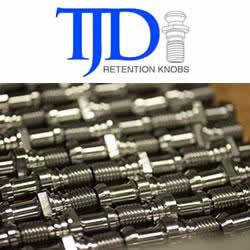
T.J. Davies' Retention Knobs
Our retention knobs are manufactured above international standards or to machine builder specifications. Retention knobs are manufactured utilizing AMS-6274/AISI-8620 alloy steel drawn in the United States. Threads are single-pointed on our lathes while manufacturing all other retention knob features to ensure high concentricity. Our process ensures that our threads are balanced (lead in/lead out at 180 degrees.) Each retention knob is carburized (hardened) to 58-62HRC, and case depth is .020-.030. Core hardness 40HRC. Each retention knob is coated utilizing a hot black oxide coating to military specifications. Our retention knobs are 100% covered in black oxide to prevent rust. All retention knob surfaces (not just mating surfaces) have a precision finish of 32 RMA micro or better: ISO grade 6N. Each retention knob is magnetic particle tested and tested at 2.5 times the pulling force of the drawbar. Certifications are maintained for each step in the manufacturing process for traceability.