
CWC and PMMI Collaborate To Sponsor Life Cycle Assessment Framework
Two-year, ISO-aligned initiative will deliver a site-specific LCA template to help municipalities and waste operators consistently measure greenhouse gas emissions, material recovery, and circular product outputs from landfill- and incinerator-based RRG systems.
Key Largo, Florida; Jan. 7, 2026 — The Consortium for Waste Circularity (CWC) and PMMI, The Association for Packaging and Processing Technologies, today announced their sponsorship of a University of Florida-led research initiative to develop a standardized Life Cycle Assessment (LCA) framework for evaluating the environmental performance of Regenerative Robust Gasification (RRG) at landfills and incinerators.
The two-year research and development effort is led by Dr. Bruce Welt, professor of Packaging Engineering, and Dr. Ziynet Boz, assistant professor Circular Foods and Packaging Systems at the University of Florida. The research is focused on creating a rigorous, ISO-aligned, site-specific LCA template. Once completed, the framework will enable municipalities and landfill operators to quantify greenhouse gas emissions, material recovery, and circular product outputs using a consistent, science-based methodology.
By providing a standardized approach to environmental impact assessment, the LCA template will support data-driven infrastructure planning, permitting, and policy decisions, while improving transparency and comparability across landfill-based and incineration waste management strategies.
"This Life Cycle Assessment framework provides the scientific foundation needed to assess Regenerative Robust Gasification at scale," says Mike Ferrari, president of CWC. "This structured template enables municipal projects to easily apply LCA methods using local data."
"Standardization is essential to making meaningful progress on circularity," said Jim Pittas, president and CEO of PMMI. "This ISO-aligned Life Cycle Assessment framework will help communities evaluate Regenerative Robust Gasification using consistent, science-based metrics—supporting more informed infrastructure planning, permitting, and policy decisions."
The project will incorporate primary data from RRG trials alongside authoritative public datasets and peer-reviewed literature, in accordance with ISO 14040 and ISO 14044 standards, allowing results to reflect site-specific and regional conditions.
Through this sponsorship, CWC and PMMI aim to support credible, academically led research that helps local governments and waste authorities better understand and evaluate the environmental implications of landfill-based waste management options. This should lead to breakthroughs, closing the recycling gap through the creation of true waste circularity.
About the Consortium for Waste Circularity (CWC)
The Consortium for Waste Circularity is a North American nonprofit 501(c)3 organization representing brands, printers and packaging suppliers. CWC advances circular economy solutions for hard-to-recycle waste materials to close the gap at landfills and incinerators. CWC supports the pathway to zero waste through research sponsorship, education, collaboration, and data-driven analysis.
Featured Product
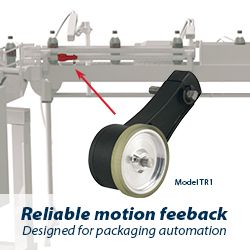
Model TR1 Tru-Trac
The Model TR1 Tru-Trac® linear measurement solution is a versatile option for tracking velocity, position, or distance over a wide variety of surfaces. An integrated encoder, measuring wheel, and spring-loaded torsion arm in one, compact unit, the Model TR1 is easy to install. The spring-loaded torsion arm offers adjustable torsion load, allowing the Model TR1 to be mounted in almost any orientation - even upside-down. The threaded shaft on the pivot axis is field reversible, providing mounting access from either side. With operating speeds up to 3000 feet per minute, a wide variety of configuration options - including multiple wheel material options - and a housing made from a durable, conductive composite material that minimizes static buildup, the Model TR1 Tru-Trac® is the ideal solution for countless applications.