
VTT has 3D printed a smart metal part: a step towards artificial intelligence
VTT Technical Research Centre of Finland, which is developing future manufacturing concepts, has succeeded in 3D printing a smart shaft. Novel is the overall process management chain in particular: 3D printing, sensor technology, wireless data transfer, and condition monitoring in the same package. The new manufacturing methods will enable the creation of new business models and provide a competitive edge in developing AI.
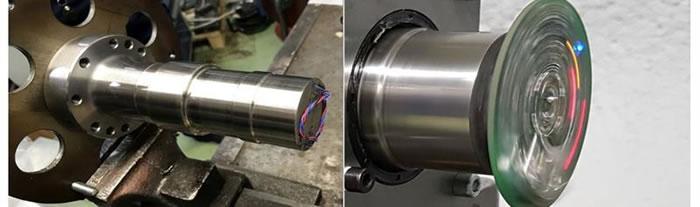
The digital revolution in manufacturing technology lies in additive manufacturing, the 3D printing of items based on digital models. This enables the tailoring of parts and rapid manufacture on demand. The most intense competition in technological development within this sector concerns smart solutions. There is widespread investment in R&D, but few have succeeded in developing a working solution, in which sensors form a functional part of a 3D printed metal structure.
VTT's proof of concept demo showed that a range of sensors or smart identifications can be added to 3D printed metal parts during manufacture, in order to track the performance and condition of machines or devices, or verify the authenticity of the parts.
"We performed a successful smart component demo, in which we explored potential technologies.
During the manufacturing phase, we embedded an accelerometer and the necessary wiring into a 3D printed metal shaft for a friction bearing. In addition, electronics allowing wireless communication were installed on the bearing. We were able to demonstrate the reliability of the shaft’s measurement technology and data transfer on a bearing test bench. The rapid collection and use of accurate data markedly increase when data is directly transferred from the component to the cloud wirelessly. This will enable us to take the next big step towards artificial intelligence," says Research Team Leader Pasi Puukko.
The method provides the designer with a much higher degree of freedom compared to traditional manufacturing methods. For example, a device with a wear-measuring sensor provides up-to-date information allowing the necessary maintenance to begin automatically, without breaks in production.
The developed method has a wide range of possible applications: from the manufacture of industrial machines to the energy, mining and transport industries. Embedded sensors are ideal for demanding conditions, because the sensors and wiring are protected inside the component, and normal functioning is unimpeded by extraneous wiring on the surfaces of structures.
Companies are welcome to join VTT in developing intelligent components.
Featured Product