
3D-printing of glass now possible
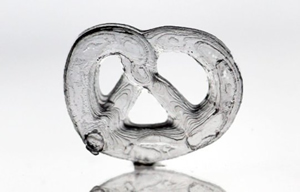 Karlsruhe Institute of Technology via Science Daily: Three-dimensional printing allows extremely small and complex structures to be made even in small series. A method developed at the KIT for the first time allows also glass to be used for this technique. As a consequence of the properties of glass, such as transparency, thermal stability and resistance to acids, the use of this material in 3D-printing opens up manifold new applications in production and research, such as optics, data transmission, and biotechnology. The process is published in “Nature” and also presented at the Hanover Fair.
Glass is one of mankind’s oldest materials. It was used as far back as in ancient Egypt and ancient Rome and has found a place now also in manufacturing technology of the 21st century. An interdisciplinary team at the KIT led by mechanical engineer Dr. Bastian E. Rapp developed a process using glass for additive manufacturing techniques. The scientists mix nanoparticles of high-purity quartz glass and a small quantity of liquid polymer and allow this mixture to be cured by light at specific points – by means of stereolithography. The material, which has remained liquid, is washed out in a solvent bath, leaving only the desired cured structure. The polymer still mixed in this glass structure is subsequently removed by heating. “The shape initially resembles that of a pound cake; it is still unstable, and therefore the glass is sintered in a final step, i.e. heated so that the glass particles are fused,” explains Rapp. He conducts research at the KIT Institute of Microstructure Technology and heads a working group of chemists, electrical engineers, and biologists. The scientists present the method in the “Nature” journal under the title of “Three-dimensional Printing of Transparent Fused Silica Glass.” Full Article:
Comments (0)
This post does not have any comments. Be the first to leave a comment below.
Featured Product