Toward additive manufacturing
 Phys.org: Automation, robotics, advanced computer-aided design, sensing and diagnostic technologies have revolutionized the modern factory, allowing the building of complex products, from microchips to cars and even airplanes, with unprecedented cost-efficiency, scale and reliability. The modern factory represents the pinnacle of mass production technology, refined over a hundred years or more, to produce identical items for mass consumption at the lowest cost.
Every manufacturing line is uniquely designed and configured for one specific product or component. Setting up an assembly line to produce a new item is a costly and painstaking process, involving iterative design and prototyping within the constraints of available mass production technologies. This includes the creation and configuration of molds, installation and configuration of equipment, designing, testing and troubleshooting processes, and quality testing of the final product. The lengthy process results in long lead times and presents significant obstacles to item customization and the production of small batches or very complex pieces.
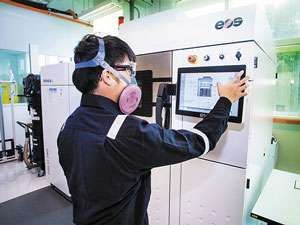
Additive manufacturing, known as 3-D printing, looks set to turn this traditional model on its head. In contrast to using a dedicated assembly line for a single item, additive manufacturing uses a single high-technology production line to create many different items without the design constraints and startup costs of conventional mass production.
"Additive manufacturing is today mainly used for high-value, high-complexity and low-volume production," says A*STAR's Advanced Remanufacturing and Technology Centre (ARTC) Senior Group Manager, Stuart Wong Sow Long. "With the advancement of technologies such as high-performance computing and sensor technology, however, the industrialization of additive manufacturing is accelerating."
The envisaged 'smart factories' seamlessly bring technologies such as the 'internet of things', cloud computing, advanced robotics, real-time analytics and machine learning together around a versatile additive manufacturing hub, and enable the production of customized products at mass scales, cheaply and quickly.
Stuart notes that "future factories will be able to create products that were not possible before, producing design geometry impossible to manufacture by traditional machining processes." Accordingly, A*STAR has established the Factory of the Future program at the Advanced Remanufacturing and Technology Centre to ensure that Singapore will become one of the key global players in this emerging sector. Full Article:
Featured Product